
Commercial Locksmith
Commercial Lock Rekeying in Southeastern PA and Northern Delaware
Business locks rekeyed so former keys stop working, across Chester, Delaware and Montgomery counties and northern New Castle County, DE.
- 3 years in business
- Open 6 days a week
- Cars, homes and businesses
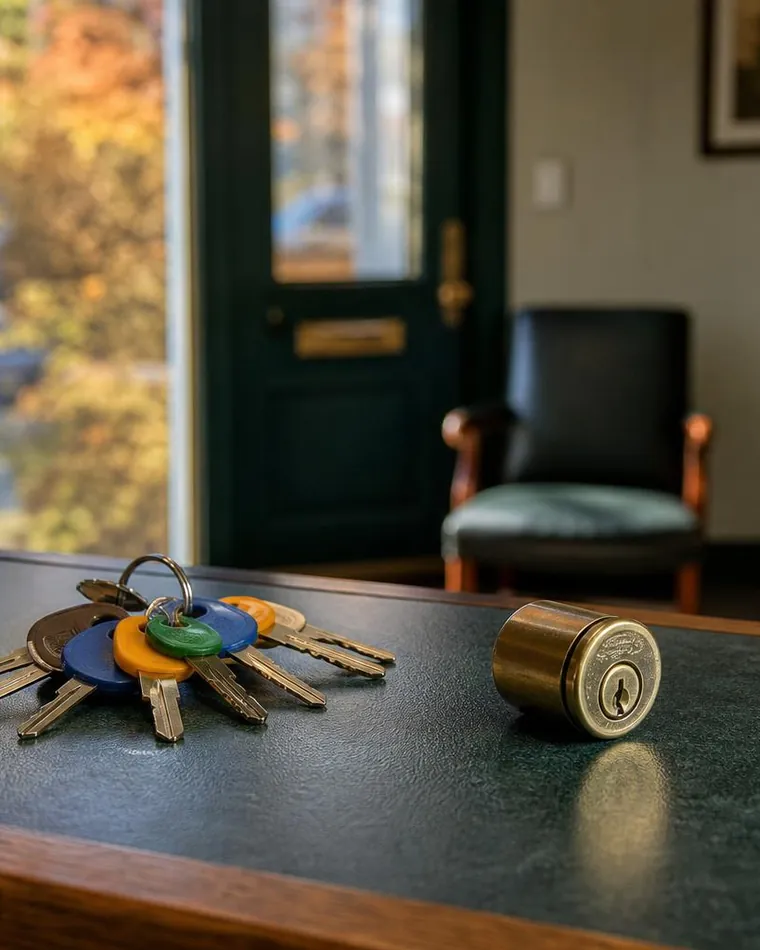
What commercial lock rekeying covers
Rekeying changes the cylinder inside a business door lock so its former operating keys no longer work.
You get a different key for that door while keeping the existing hardware, provided it is suitable for rekeying. This gives you a way to control access when an employee leaves, a copy goes missing, or a new tenant takes over a space. It does not affect copies for doors that are left out of the work, so choosing which openings to include matters.
You may want to start with exterior entrances and doors to areas that hold inventory, records or equipment. We can arrange selected doors to work with one shared key where the hardware allows, or keep access separate for different areas. If your building uses a master key plan, we can rekey selected doors to fit that plan when the hardware and system allow it. An existing master key may still open those doors, even though their former individual keys no longer do. If a cylinder is worn or cannot be rekeyed to the arrangement you need, replacing it may be an option. The choice comes down to which doors need restricted access and who needs broader access across the building.
Signs you need commercial lock rekeying
A departing employee may still have a key, or you may find that copies are missing from the place where you keep them.
A lost set is another warning, especially if it includes access to an entrance, a stockroom, or a room with sensitive records. Even if someone returns what they were given, you may not know whether copies were made. As a new tenant, you may be unsure who had access under the previous occupant, particularly where several businesses have shared an entrance.
Look closely at which doors give access to the spaces you need to protect. A delivery entrance that opens into inventory or a shared hallway leading to private offices may matter more than a closet containing ordinary supplies. Your existing master key plan can also reveal a problem: if one person's copy opens several areas and you no longer know where that copy is, access may be broader than you intended. A list of entrances, restricted rooms, and the copies you can account for gives you a useful starting point.
How the work goes
When you call, tell us which business doors you want rekeyed and which keys need to keep working.
A door list, the keys you have and any record of your existing master key plan give us a useful starting point. You can choose exterior entrances, shared spaces or selected rooms rather than every door. We will ask how you want access divided, including whether one key should operate several doors and whether individual keys should open only certain ones. If you are unsure which doors belong in the plan, we will work through the choices with you.
We examine the locks and available keys, then explain whether the doors can fit your existing master key plan or need a different arrangement. Keeping an existing master key means it will still operate any door assigned to it, so tell us if a copy of that key is among those you no longer trust. We rekey the selected cylinders and test the keys assigned to each door, including any master key meant to remain active. You receive the working keys and an account of which doors they operate, so you can distribute them according to your access plan.
- You callWhich doors, who uses them.
- A few questionsHours and who holds keys.
- The plan, firstHardware and keys explained.
- Tested with youEach door we worked on.
Commercial Lock Rekeying by town
We are based in West Chester and provide commercial lock rekeying in towns in Chester, Delaware and Montgomery counties in Pennsylvania, as well as northern New Castle County in Delaware.
Our service area includes communities on both sides of the state line. Coverage varies by town in the Pennsylvania counties. If your business has more than one location, the address of each property matters when checking whether it is in our service area. The street address is useful even when your mailing address is different from the location where you need the work done.
Commercial Lock Rekeying questions
A former employee had several keys. Which doors should I rekey first?
We can focus on doors that give access to sensitive areas, such as exterior entrances, record rooms and storage spaces. Make a list of the keys the employee held and the doors each one opens. A key may work on more doors than its label suggests, so include shared entrances and any areas with confidential information.
Our building has a master key. Can rekeyed doors stay in that plan?
We can assess whether the rekeyed doors can fit your existing master key plan. Your master key would open the doors assigned to it, while individual keys would open only their assigned doors. Tell us which people need access to which areas, including any doors that should remain outside the plan.
We have a spare key we like. Can we keep using it?
We can assess whether your existing key is suitable for the doors you want rekeyed. Keeping it may be convenient, but any unaccounted copy of that key could also work on those doors. If a copy is missing or held by someone who should not have access, choose a different key instead.
Our office has different locks on its doors. Can one key open them all?
We can check whether those locks accept compatible keys and can be set up alike. If they cannot, you may need separate keys or replacement hardware for some doors. One key is convenient for someone who needs broad access, but separate keys give you more control over who can enter each area.
We have several managers with keys. How should we track their copies?
Keep a record of each key issued, who received it and which doors it opens. Give each key a label that refers to your records rather than naming the room or business. When you change access, update the record and collect keys where possible. Copies that have not been returned should still be treated as usable.
More commercial locksmith services

Commercial Lock Installation
Commercial grade locks and lever sets for business doors.

Commercial Lock Repair
Business locks that stick, wear or fail to latch, repaired.

Master Key Systems
A key for each person and one master key for every door.

Panic Bar Installation
Panic bars and exit devices installed on business doors.

Door Closer Installation
Door closers installed and adjusted so doors close and latch.

Keyless Entry Systems
Keypad and code locks for business doors, a code per person.
Back to the group
Need a hand with a lock?
We take calls Sunday to Thursday from 7 AM to 10 PM and Friday from 7 AM to 4 PM.
Call (484) 488-7719